Only 5,000 an hour? That number is half the story
At IBIE and in our calls with US operators, the same line comes back almost every time. Someone looks at the datasheet, raises an eyebrow, and says it out loud: your machine only does 5,000, maybe 7,000 pieces an hour?
It is a fair question. And the honest answer is not a bigger number. It is a second number.
How many pieces a deep-frying line makes per hour is never one figure. It is two, and they belong together. The first one is printed on the datasheet. The second one comes from your recipe. Leave either one out and a comparison between two machines quietly turns into a comparison between two promises.
Let me show where both numbers come from, because once you see it, the whole 5,000-versus-20,000 conversation looks different.
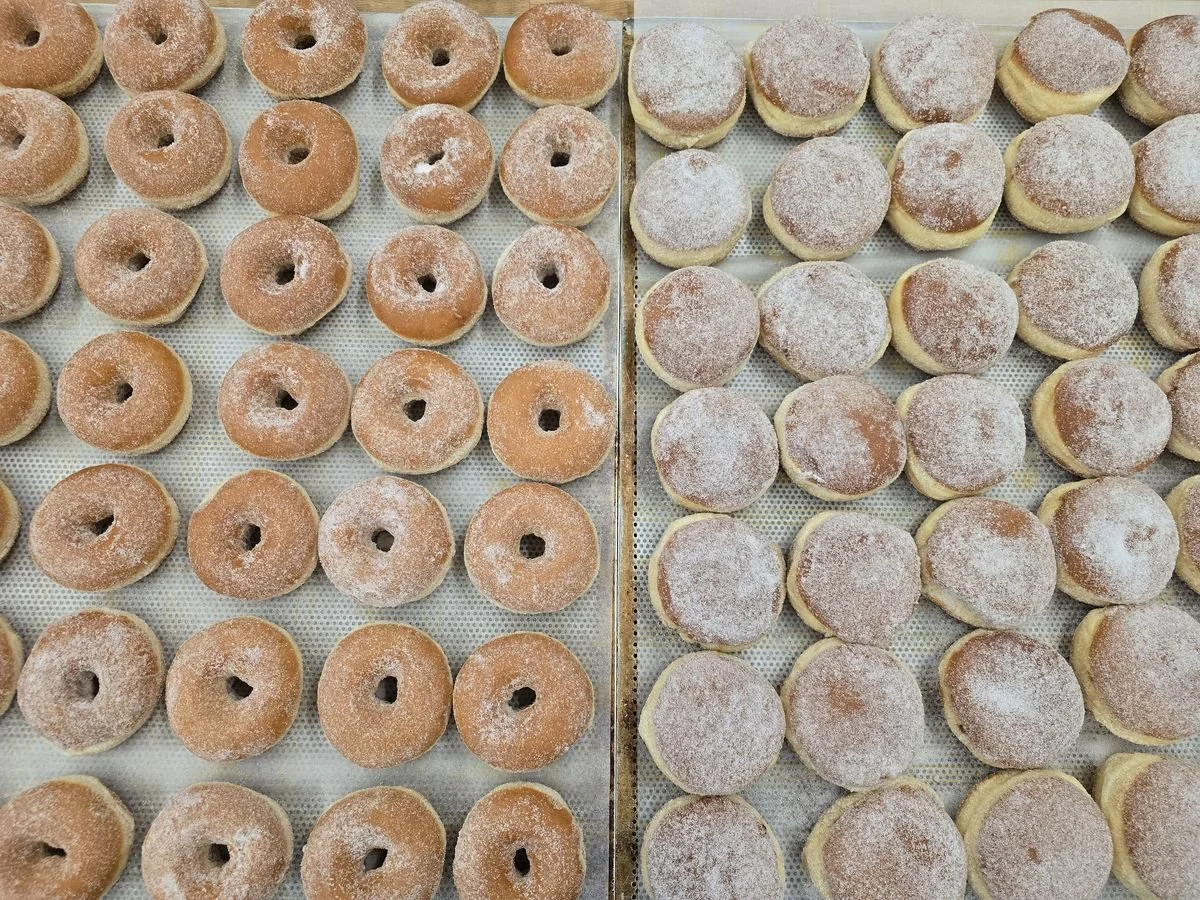
American donuts on the left, German Berliner on the right. Same fryer, two recipes – and two very different fry times.
What pieces per hour actually measures
A fryer does not fry one piece at a time. It fries in rows, and the rows move through the oil at a fixed pace. So the hourly figure is not a property of a single Berliner or a single donut. It is the result of two things: how many pieces are in the oil at the same time, and how long each one needs before it comes out.
The math behind it is as simple as it gets. Pieces in the oil, divided by the fry time in minutes, times sixty. That is all. And because it is that simple, it pays to keep the two numbers clean and separate.
The first number is a property of the machine. It is written into the model name. An FG 8-25 runs eight pieces across and twenty-five rows. That is two hundred pieces sitting in the oil at once. This figure is physical – built, measured, not negotiable.
The second number is your decision. Fry time follows the recipe and the weight of the dough piece. Six minutes is the value we compare against – at least here in Germany, where it is the reference the trade has settled on for the Berliner. It does not describe an ideal piece, and it is not a recommended process. It is simply the fry time that lets a baker put machine X and machine Y side by side without comparing apples to oranges.
That is why we publish at six minutes online and in our standard documents – so the numbers stay comparable across suppliers. A supplier who quotes at five and a half minutes looks better on paper without the line producing a single piece more. For an individual customer we of course recalculate: your recipe, your dough weight, the fry time you actually run. The six-minute figure is for the comparison. The number you plan your shift around is your own, and we work it out with you.
Six minutes or ninety seconds
Here is where the US conversation usually turns.
A German baker fries a Berliner in around six minutes. The dough is heavier, generously filled with jam later on, and turned three times in the oil – that is the standard nobody back home questions. A North American donut is a different product entirely. Lighter, with a hole in the middle, often out of the oil in ninety seconds.
Same machine. Same two hundred places in the oil. The only thing that changed is the fry time – and the hourly number moves by a factor of four.
| Fry time | Pieces per hour |
|---|---|
| 1:30 (donut) | 8,000 |
| 3:00 | 4,000 |
| 4:30 | 2,670 |
| 6:00 (Berliner) | 2,000 |
| 7:30 | 1,600 |
So when an operator looks at the FG 8-25 and sees 2,000, that is the Berliner figure at six minutes. Run a ninety-second donut on the same line and you are at 8,000. Nothing about the steel changed. The recipe did.
That is the answer to the eyebrow at the booth. Yes, around 2,000 in German Berliner. And four times that in donuts, on the exact same machine.
Across the line-up
The same logic holds for every configuration of the FG line. The machine scales in width (pieces per row) and in length (number of rows). Here are four configurations, each shown at the German Berliner reference of six minutes and at a ninety-second donut.
| Model | In the oil | at 6:00 (Berliner) | at 1:30 (donut) |
|---|---|---|---|
| FG 6-16 | 96 | 960 | 3,840 |
| FG 8-25 | 200 | 2,000 | 8,000 |
| FG 10-35 | 350 | 3,500 | 14,000 |
| FG 12-42 | 504 | 5,040 | 20,160 |
Read the FG 12-42 row again. Around 5,040 in Berliner – that is the figure that drew the eyebrow. The same line, set up for donuts at ninety seconds, runs north of 20,000. And because a donut is smaller than a Berliner, with more sitting in the oil, the largest configurations reach higher still. The "5,000 to 7,000" you saw on the datasheet and the donut throughput you actually need are not in conflict. They are the same machine, read at two different fry times.
So the question is never just "how many pieces per hour." It is "how many pieces per hour, at which fry time, for which product." When a customer tells us they need 8,000 an hour and wants to see the FG 8-25, the next question is: in what. At ninety-second donuts, it fits. At six-minute Berliner, it does not. That belongs in the conversation before the quote goes out.
From the datasheet to the real number
The math so far is the clean one. In a running bakery, three things sit between the datasheet and the floor – and on a US site, with labor where it is, each one carries real money.
First, full rows. A row goes through the oil empty when the operator does not load it in time, and every empty row is capacity lost for nothing. When the line is fed by hand, our light barriers catch those gaps and keep the rows closed. I genuinely do not want empty rows in the fat – I want every row filled, straight through, so the hourly capacity actually shows up at the discharge end. Leave five percent of your rows short and you lose five percent of your output. On an 8,000-an-hour donut line, that is four hundred pieces. At donut speeds, though, most operators do not feed by hand at all. They run a continuous automatic proofer in front of the line – the kind König builds, for example – and it feeds the line without a break. We combine with that equipment as a matter of course, and then there are no empty rows for us to avoid in the first place, because the feed keeps every row filled.
Second, changeover. Run one product all shift and you have the full window. On our lines a product change is usually a recipe at the touch panel – turning, heating zone and belt speed all come from the recipe, so the change collapses into a couple of minutes. On a lot of older equipment a change means a real mechanical conversion that can cost half an hour. For a multi-site operator running donuts in the morning and something else after, that difference adds up fast across a week.
Third, support across distance. This is the one US operators ask about most, and I understand why – the country is large and a service van is not always an hour away. We support our lines digitally. Sensor data flows into a secure cloud, we see what is happening online, and most of it is a phone call with the operator. When a part needs to change, we ship the spare on 24-hour service, and because we build with standard components, the customer's own electrician or mechanic can fit it. Suriname is further from our works than most of the US is. It works there. It works across a large country too.
These three are the difference between the datasheet and the floor. If you want to plan honestly, plan all three in.
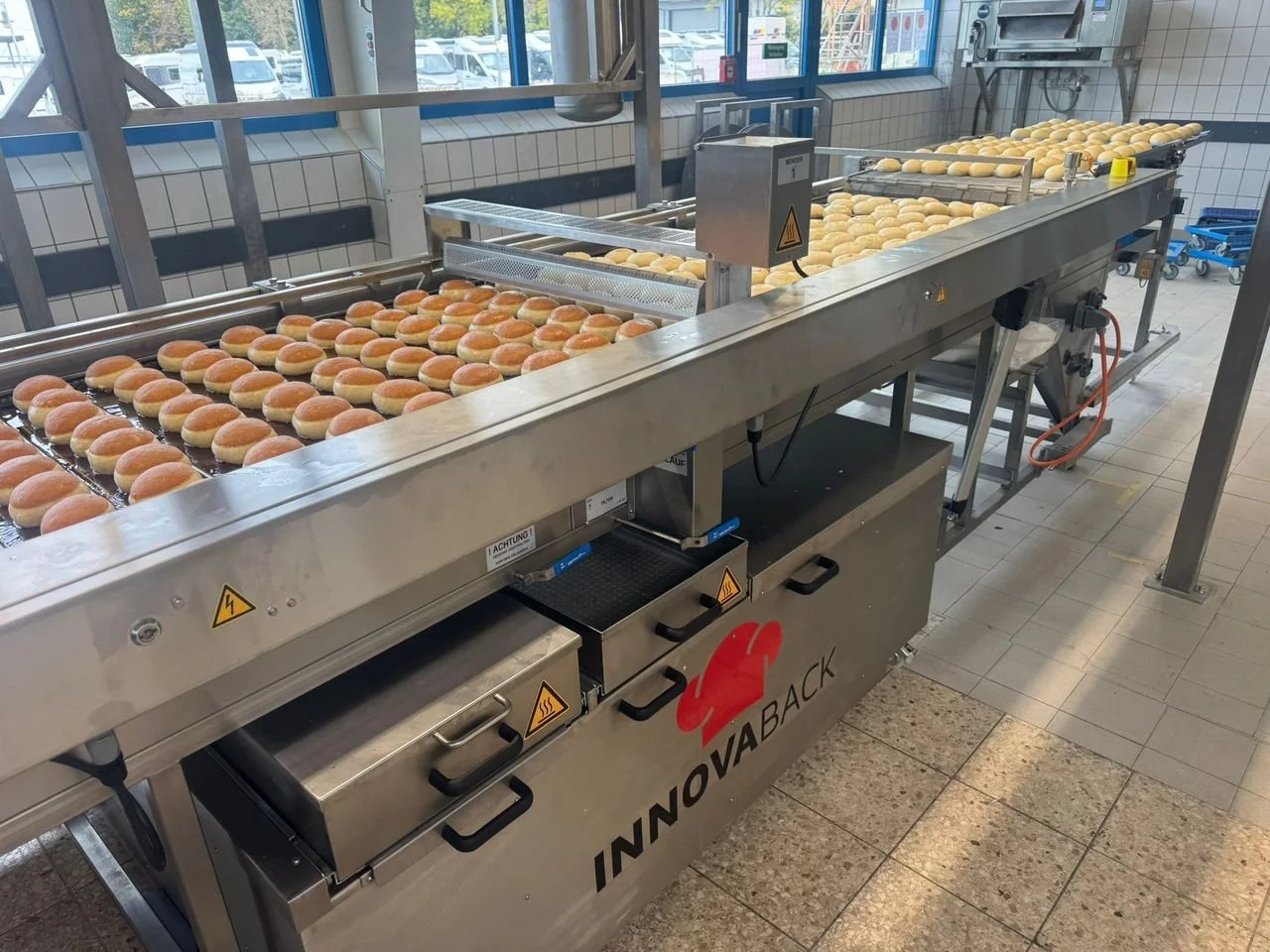
Full rows: The capacity on the datasheet only reaches the shop if every row is actually filled.
When you are stuck between two sizes
Run this math on your own product and you do not always land on one clear model. Often you sit between two sizes – say between an FG 8-25 and an FG 10-35. At that fork we now give every customer the same recommendation: when in doubt, take the larger one.
Two reasons. The first is the fast product changes the digital control makes possible. On the larger line you can run more variety – donuts, filled donuts, a second pastry – without running into shift conflicts. More variety in the case means more pieces sold over the counter.
The second is demand itself. When product of this quality is sitting in the shop, customers see it, buy it, come back for it. After start-up, sales often climb faster than the plan assumed – and US operators who are scaling across sites feel that pull harder than most. Buy right at the edge and you regret it within a year.
We know the sentence that describes this, and we have heard it from more than one customer: "We were right to buy InnovaBack. We just should have bought one size up."
Run your real fry time, then buy the line that still fits in five years – not the one that just fits today.